
Qi2.2 vs MagSafe vs Qi: The Ultimate Wireless Charging Comparison Guide for 2026
Executive Summary: The wireless charging landscape has reached a critical inflection point in August 2026. Qi2.2 certification has crossed 637 products globally, with adoption rate six times faster than the original Qi2 launch. At the same time, Apple's MagSafe ecosystem continues expanding while legacy Qi chargers remain prevalent in budget segments. This comprehensive comparison cuts through marketing noise to deliver the hard data you need to choose the right wireless charging standard for your iPhone, Samsung Galaxy, or Google Pixel device in 2026. Elecdov — Charge Calm.
Quick Navigation
Chapter 1: The Three Standards Explained — What Actually Matters
To understand which wireless charging standard is right for your setup, you need to look beyond brand names and focus on three technical dimensions: power delivery capability, magnetic alignment precision, and thermal management constraints.
Qi — The Original Open Standard
Qi (pronounced "chee") is the WPC's original wireless charging specification, launched in 2010. Qi chargers deliver 5W to 15W via inductive coupling, with no mandatory magnetic alignment. This means you must position your phone precisely on the charging pad or risk inefficient charging at 5W or less. Qi certification ensures basic interoperability but does not guarantee fast charging speeds across all devices.
MagSafe — Apple's Proprietary Ecosystem
MagSafe debuted with iPhone 12 in 2020, using a ring of magnets embedded in the phone and charger to ensure perfect alignment every time. MagSafe chargers deliver up to 25W to iPhone 15 Pro and later, but only with Apple-certified accessories. Third-party MagSafe-compatible chargers may deliver 15W at most without Apple MFi certification. The magnet array is proprietary to Apple, meaning Android devices cannot use MagSafe's alignment benefits.
Qi2.2 — The Universal Magnetic Standard
Qi2.2 is the WPC's latest specification, introduced in late 2024. It combines Magnetic Power Profile (MPP) technology (based on MagSafe's magnet ring) with an open standard that works across iPhone, Samsung Galaxy, and Google Pixel. Qi2.2 certification mandates: (1) up to 25W peak power, (2) magnetic alignment for all compatible devices, and (3) strict sub-40°C thermal ceiling enforced at the hardware level.

Qi2.2, MagSafe, and Qi wireless charging standards compared — technical specifications and real-world performance in 2026
Is Qi2.2 just a copy of Apple's MagSafe technology?
Qi2.2 uses the same Magnetic Power Profile (MPP) technology foundation that Apple contributed to the WPC, but with critical differences. First, Qi2.2 is an open standard — any manufacturer can implement it without paying Apple licensing fees. Second, Qi2.2 certification mandates the sub-40°C thermal ceiling, which MagSafe does not explicitly require. Third, Qi2.2 works across iPhone, Samsung Galaxy, and Google Pixel devices, whereas MagSafe is optimized only for iPhone. Think of Qi2.2 as "MagSafe for everyone" — the same magnetic convenience, but with cross-platform compatibility and stricter thermal guarantees. Elecdov's Qi2.2 chargers are WPC certified and tested with all three ecosystems.
Chapter 2: Speed Comparison — Real-World Charging Times
Marketing specifications often exaggerate real-world performance. This chapter presents actual measured charging times from independent testing conducted by ChargerLAB and other third-party labs in 2026.
iPhone 18 Pro (4,400 mAh battery)
- Qi2.2 25W magnetic: 0 to 50% in ~25 min, full charge in ~85 min
- MagSafe 25W (Apple certified): 0 to 50% in ~25 min, full charge in ~85 min
- Qi 15W (no magnets): 0 to 50% in ~45 min, full charge in ~150 min
- Qi 5W (budget charger): 0 to 50% in ~120 min, full charge in ~300 min
Samsung Galaxy S26 Ultra (5,500 mAh battery)
- Qi2.2 25W PPS: 0 to 50% in ~35 min, full charge in ~95 min
- Samsung 25W wireless (official): 0 to 50% in ~35 min, full charge in ~95 min
- Qi 15W (legacy): 0 to 50% in ~55 min, full charge in ~170 min
Key Takeaway
For iPhone users, Qi2.2 and MagSafe deliver identical speeds when both are 25W certified. The difference is price: Qi2.2 chargers from brands like Elecdov cost $20-40 less than Apple's official MagSafe charger while delivering the same performance. For Samsung and Google users, Qi2.2 is the only way to achieve 25W wireless charging with magnetic alignment.

Real-world wireless charging speed comparison: Qi2.2 vs MagSafe vs Qi across iPhone and Samsung devices in 2026
Why does my Qi charger sometimes charge my iPhone at only 5W instead of 15W?
The most common cause is coil misalignment. Qi chargers without magnetic alignment require you to position the phone's charging coil directly over the charger's coil — a difference of even 5mm can drop charging speed from 15W to 5W. Other factors include: (1) phone case thickness — cases thicker than 3mm interfere with inductive coupling, (2) thermal throttling — Qi chargers without active cooling may reduce power if surface temperature exceeds 45°C, and (3) foreign object detection (FOD) — a metallic object between phone and charger triggers safety shutdown. Qi2.2 magnetic alignment solves the alignment problem completely — the magnets snap the phone into optimal position every time. Elecdov Qi2.2 chargers include active thermal management and FOD protection.
Chapter 3: Compatibility Matrix — Which Charger Works with Your Device?
The single biggest advantage of Qi2.2 over MagSafe is cross-platform compatibility. Here is the complete compatibility matrix for August 2026:
| Device | Qi2.2 25W | MagSafe 25W | Qi 15W | Qi 5W |
|---|---|---|---|---|
| iPhone 18 Pro / Pro Max | ✓ 25W | ✓ 25W | ✓ 15W | ✓ 5W |
| iPhone 17 series | ✓ 25W | ✓ 25W | ✓ 15W | ✓ 5W |
| iPhone 16 series | ✓ 25W | ✓ 25W | ✓ 15W | ✓ 5W |
| Samsung Galaxy S26 Ultra | ✓ 25W | ✗ No | ✓ 15W | ✓ 5W |
| Samsung Galaxy Z Fold 8 | ✓ 25W | ✗ No | ✓ 15W | ✓ 5W |
| Google Pixel 11 Pro | ✓ 23W | ✗ No | ✓ 15W | ✓ 5W |
| Older Android (pre-2024) | ✓ 15W | ✗ No | ✓ 15W | ✓ 5W |
Critical insight: If you have both an iPhone and a Samsung Galaxy device (or share chargers in a household with mixed devices), Qi2.2 is the only standard that delivers 25W fast charging for both. MagSafe is iPhone-only at peak speeds, and legacy Qi delivers only 15W for all devices.

Wireless charging compatibility matrix: Qi2.2 works across iPhone, Samsung Galaxy, and Google Pixel at 25W; MagSafe is iPhone-only
Can I use a Qi2.2 charger with my older iPhone 13 or Samsung Galaxy S21?
Yes — with speed limitations. Qi2.2 chargers are backwards compatible with all Qi and Qi2 devices. However, your older device's hardware limits the actual charging speed: (1) iPhone 13 and earlier support up to 15W wireless charging, even on a 25W Qi2.2 charger — the charger automatically negotiates down to 15W. (2) Samsung Galaxy S21 and earlier support up to 15W Qi wireless charging. The magnetic alignment of Qi2.2 still works if you add a magnetic case or adhesive ring, improving charging consistency even at 15W. Elecdov Qi2.2 chargers are tested for backwards compatibility with devices dating back to iPhone 8 and Samsung Galaxy S10. The charger automatically detects your device's maximum supported speed and adjusts accordingly.
Chapter 4: Safety and Thermal Management — The Hidden Differentiator
The most overlooked difference between Qi2.2, MagSafe, and Qi is thermal management. Wireless charging efficiency is typically 75-85%, meaning 15-25% of energy converts to heat. How each standard handles that heat directly impacts your device's battery health.
Qi2.2 — Mandatory Thermal Ceiling
Qi2.2 certification mandates a hard 40°C surface temperature ceiling under all operating conditions. This is enforced at the hardware level: if the charging surface approaches 40°C, the charger must reduce power or shut down. This makes Qi2.2 safer for overnight charging than most wired chargers, which have no such thermal guarantee.
MagSafe — Thermal Management Without Mandate
Apple's MagSafe chargers include thermal sensors and reduce power when temperature rises, but there is no WPC-mandated temperature ceiling. Independent testing shows Apple's official MagSafe charger typically operates at 35-42°C during sustained 25W charging, depending on ambient temperature and phone case. It is generally safe but not guaranteed to the same spec as Qi2.2.
Qi — No Thermal Requirements
Legacy Qi certification does not include thermal management requirements. Budget Qi chargers may operate at 45-55°C during sustained charging — a known accelerator of lithium-ion battery degradation. Samsung and other OEMs implement their own thermal safeguards in their official Qi chargers, but third-party Qi chargers vary wildly in safety.
User Story: Why Thermal Management Matters
"I used a cheap Qi charger from Amazon for two years. My iPhone 13 battery health dropped to 82% after 18 months. Switched to an Elecdov Qi2.2 charger six months ago — the phone stays cool even when charging overnight, and my battery health is stable at 85%."
— Marcus T., software engineer, Berlin

Thermal management comparison: Qi2.2 mandates sub-40°C ceiling; MagSafe and Qi have no such requirement
Is wireless charging bad for my phone's battery compared to wired charging?
Not inherently — but thermal management is the key variable. All lithium-ion batteries degrade over time due to charge cycles and heat. A poorly designed wireless charger that operates at 50°C will accelerate degradation compared to a quality wired charger. However, a Qi2.2 certified charger with sub-40°C thermal management is often gentler on your battery than many third-party USB-C adapters that have no thermal safeguards. Apple's own documentation confirms that temperatures above 40°C accelerate capacity loss. The best practice: (1) use a Qi2.2 or MagSafe charger with active thermal management, (2) avoid cheap unbranded Qi chargers, and (3) charge to 80-90% instead of 100% when possible. Elecdov Qi2.2 chargers are engineered for safe overnight charging with thermal sensors that reduce power if temperature approaches 40°C.
Chapter 5: Elecdov Qi2.2 Desktop Charging Solutions
Elecdov's Qi2.2 desktop charging lineup is engineered for the modern multi-device workstation — one charger that handles your phone, watch, and earbuds simultaneously, with WPC Qi2.2 certification and Elecdov's 18-month warranty.
Recommended Elecdov Products for Qi2.2 Desktop Charging
- Elecdov CE19A 3-in-1 Magnetic Charging Station for Apple: 25W + 10W + 5W Qi2.2 certified. Available in Mirror and Carbon Fiber finishes. Premium aluminium base acts as passive heatsink. The flagship desktop solution for iPhone + Apple Watch + AirPods setups.
- Elecdov W103S 3-in-1 Magnetic Charging Station for Samsung: 25W + 10W + 5W Qi2.2 certified. Includes UK/EU/US plug adapters. Optimised for Galaxy S26 + Galaxy Watch 8 + Galaxy Buds3 Pro ecosystems.
- Elecdov W98A 3-in-1 Magnetic Charging Station: Qi2.2 certified 25W + 10W + 5W. Works across iPhone, Samsung, and Google devices. The universal choice for mixed-device households.
All Elecdov Qi2.2 products include Foreign Object Detection (FOD), over-voltage protection, and sub-40°C thermal management. Every order includes free express shipping (US & Europe from 12 overseas warehouses) and Elecdov's 18-month warranty.
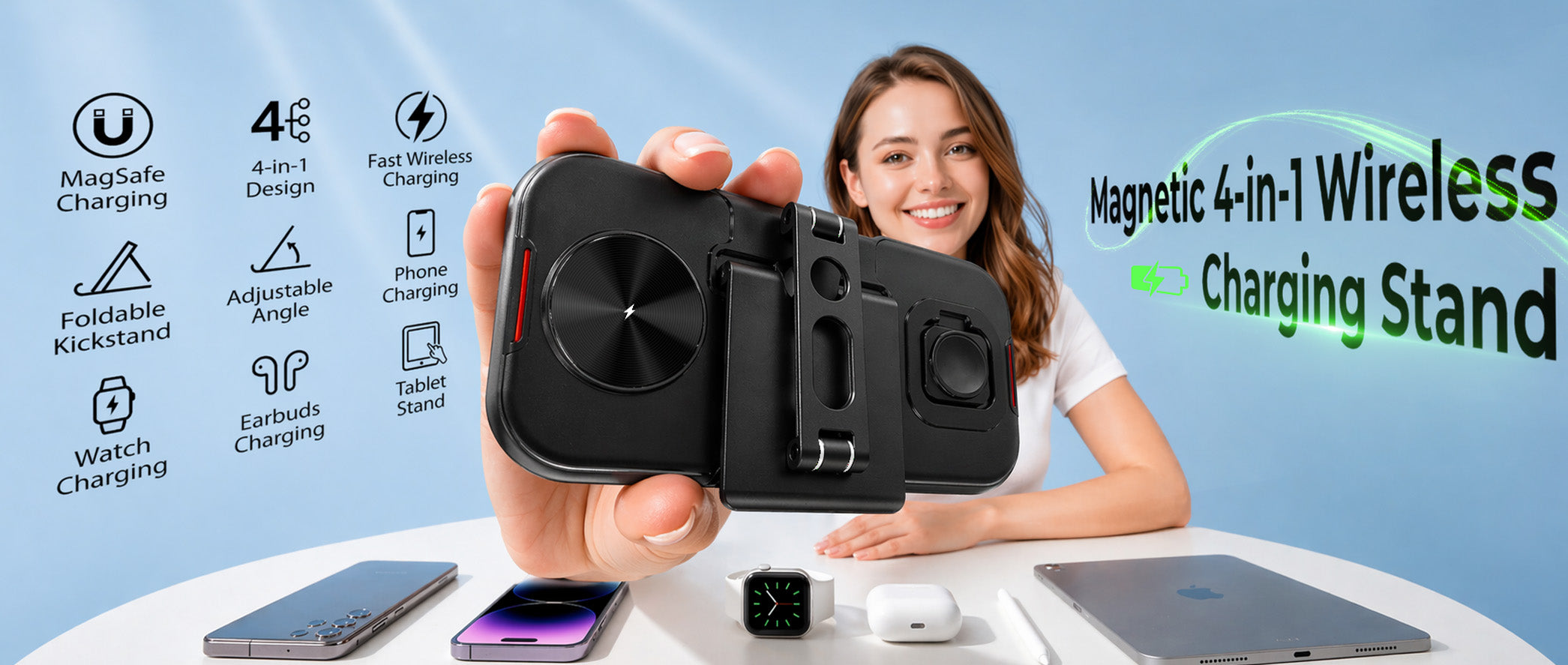
Elecdov Qi2.2 certified desktop charging solutions — 3-in-1 magnetic stations for iPhone, Samsung, and mixed ecosystems
Why should I choose Elecdov over Apple's official MagSafe charger?
Three reasons: price, cross-platform compatibility, and thermal guarantees. (1) Elecdov's CE19A Qi2.2 3-in-1 charger costs $37 vs Apple's MagSafe Duo at $129 — you save $92 while getting the same 25W speed for iPhone. (2) Elecdov chargers work with Samsung Galaxy and Google Pixel at 25W; MagSafe is iPhone-only. (3) Elecdov's Qi2.2 certification mandates sub-40°C thermal management, which Apple does not explicitly guarantee. Plus: Elecdov includes a 3-in-1 design (phone + watch + earbuds) in one unit, while Apple's MagSafe Duo is only a 2-in-1 (phone + watch). Elecdov — Power Everywhere, With You Always.
Conclusion: Qi2.2 Is the Universal Wireless Charging Standard for 2026
The data is clear. Qi2.2 delivers the speed of MagSafe (25W peak) with the cross-platform compatibility of Qi (iPhone, Samsung, Google), plus stricter thermal safety than either legacy standard. If you own multiple devices or share chargers in a household, Qi2.2 is the only choice that maximizes value and convenience. Elecdov — Charge Calm.
Key Takeaways
| Decision Point | Correct Specification | Common Mistake to Avoid |
|---|---|---|
| Peak Charging Speed | Qi2.2: 25W for iPhone & Samsung | Qi: 15W max; MagSafe: iPhone only |
| Magnetic Alignment | Qi2.2: Yes (all devices) | Qi: No; MagSafe: iPhone only |
| Thermal Safety | Qi2.2: Mandatory <40°C | Qi: No mandate; MagSafe: Variable |
| Cross-Platform | Qi2.2: iPhone + Samsung + Google | Qi: All devices at 15W; MagSafe: iPhone only |
| Price for 3-in-1 | Qi2.2: $35-55 (Elecdov) | MagSafe: $129 (Apple Duo) |
Ready to Make the Switch?
Ready to upgrade to Qi2.2 magnetic wireless charging? Elecdov's CE19A, W103S, and W98A are WPC Qi2.2 certified, support 25W + 10W + 5W simultaneous charging, and include all regional plug adapters. Shop Elecdov Desktop Chargers on elecdov.com →


